Showing posts with label New Zealand. Show all posts

23 April 2012

We’ve talked about religion, how about politics?


Last year, I tried to “give up” politics for Lent.  I am admittedly addicted to politics.  It’s like a dangerous drug, for me.  It makes me angry, crazy, and depressed, and yet once I get going I cannot stop.  It’s interesting, though, since coming to New Zealand, I’ve almost adapted the attitude of an outsider when it comes to American politics.  I almost hate to admit it, but I feel relieved that I’m here, far away from the insanity.  However, if all I’m doing is running away from one crazy system, then I’m not really experiencing the culture where I am now.  What would be the point of that?

With that in mind, I’ve decided to do a little research into the New Zealand political system and compare similarities and differences with US politics.  I’ve been working on this post, now, for over a week and so far, the best I can do is, in the words of a friend I was talking to yesterday, sound like I’m studying for a citizenship exam!

So, I’ll try to be brief about the boring stuff.  New Zealand is a Constitutional Monarchy, which means that Queen Elizabeth, II, is the Head of State of the “Realm” of New Zealand.  It is also Parliamentary Democracy with proportional representation.  Effectively, this means that there are multiple (more than 3) parties in the game and the number of seats each party has in Parliament is proportional to the number of votes the party’s candidates (and the party itself) get.  The leader of the majority party is the Prime Minister.  Currently, this is John Key, and he is a member of the National Party.  You can read all about this on Wikipedia.

New Zealand is not divided into states or provinces but is governed in its entirety by the Parliament.  Regional and territorial issues are managed by a variety of boards and councils, including District Health Boards which manage the delivery of healthcare to the people in their particular region.

The rest of this post is more observational than factual.  First off, the idea of “proportional representation” is quite appealing to me.  It lessens the probability that one party can essentially “take over” and assert its agenda to the exclusion of all other voices.  Instead of a “winner take all” system where a party has to have a winning candidate in a certain district in order to get a seat in government, New Zealand has a system where a political party only has to get 5% of the vote to have a seat in Parliament.  Mind you, in reading through the list of parties, it seems that they are all some version of the progressive/liberal/moderate/socially conservative/fiscally conservative spectrum.  On the “far left” are those who want to the government to take care of all of the social needs of its citizens and raising taxes is a good thing to do to achieve that. On the “far right” are the people who want to rein in government spending, want lower taxes, AND, in some cases have a fairly conservative social agenda.  HOWEVER, these are people that would be seen as “moderates” in the US.  The “National” party which is currently in power seems, to me, to be fairly moderate, although it is criticised for wanting to gut social programmes and for giving tax cuts to wealthy corporations and being too beholden to special interest lobbies?  Sound familiar?  Only the scale is much different.  When I read/hear these things, I shake my head and say, “If you ONLY knew.”

RELIGION, POLITICS AND “MORAL” ISSUES

One notable thing about the “socially conservative” agenda is that there is not the vitriolic rhetoric you hear in the US. First off, most people aren’t really all that concerned about what the RELIGION of the candidate is.  Of course, Christians might tend to vote for a Christian, if they thought that person would do a good job of representing their values and interests as Christians. The same goes for people of any other religion or, for that matter, culture, ethnicity, sexual orientation, or gender.  But it doesn’t become a subject that’s open to scrutiny in the question of “can this person do the job they are being elected to do?”  Second, the two biggest “litmus test” issues for conservative candidates in the US are, still, abortion and same-sex marriage.  Now, don’t even get me started on how ridiculous it is to debate these things when the gap between rich and poor is growing at a stunning rate, when children in one of the wealthiest countries in the world are starving, when people are going bankrupt because they can’t pay their medical bills.  In New Zealand, same-sex marriage is not legal and there is some debate and discussion going on about it.  However, no one is trying to amend the (non-existent) constitution to deny that right to gay people.  In fact, sexual orientation is listed in all the non-discrimination policies that I’ve ever read here. So, how does that work?  How can gay people be free of discrimination but not be able to “get married?” Well, for one thing, New Zealand DOES allow all couples to have a Civil Union which basically is legally identical to marriage.  I don’t quite get the difference, actually, since couples in a Civil Union (straight or gay) have the same access to medical decision making, inheritance, tax breaks and other benefits that married people do.  In any case, it is, for the most part, a non-issue. 

Similarly, there have been some efforts to outlaw abortion.  Briefly, groups like “Operation Rescue” came over and staged protests.  However, attempts to actually ban abortion entirely have repeatedly failed in Parliament and the issue seems to have died down and all but gone away in the political arena.  Abortion is legal in New Zealand but there are reasonable (in my opinion) restrictions.  It can only be performed if two doctors (one of whom must be an OB/GYN specialist) agree that it must be done to protect the life and/or health (physical or mental) of the woman.  It’s the “mental health” part that is invoked in most cases.  I know there are efforts, such as government subsidised contraception and family planning programmes, to try to reduce the need for abortion.  This is something I need to research a bit more, however.  I know there are abortion providers in the area but I have never seen people carrying signs with pictures of dead babies and to my knowledge, abortion providers do not go to work wearing bullet-proof vests. (But then, guns are a whole other issue.  I just found out the other day that the police are not armed!)

WHAT DO THEY CARE ABOUT?

So, with 2 of the issues that take up so much of the time of American politicians virtually out of the way, what do lawmakers have to do all day?  Well, they decide on how to spend money for things like healthcare and care for new parents and young children.  They decide on how much to spend on infrastructure and supporting business.  I’m sure they waste time on things that tax payers don’t think are important.  But if they waste too much time on those things, guess what? They get voted out! 

WORK, INCOME AND POVERTY

It is, of course, very complex to try to define poverty and then quantify it.  To make matters worse, comparing the US to NZ is extremely difficult because the two countries define poverty differently and, remember, the US is a REALLY big place with a lot of variation in income, employment, and cost of living.  New Zealand has a minimum wage of $13.50 per hour.  The NZ dollar is worth about US$0.85 but that still puts it at around US$11.45.  The US minimum wage is $7.25 per hour.  Some states have a higher minimum wage but many do not.  The minimum wage in the US is, almost universally, not enough to live on.  It seems to be designed to keep people in poverty while allowing businesses to thrive.  A worker making minimum wage in the US and working 40 hour weeks would earn about $15,000 per year.  When I went to the Bureau of Labor Statistics website I found that the workers in the lowest paying jobs in the US (burger-flippers, dishwashers, etc) had a median income in about the $18,000 range, just barely above minimum wage. On the other hand, a similar list for New Zealand had the lowest payed workers, including wait staff, baristas, caregivers, and fast food workers, making something in the $31-32,000 per year range.   Both lists had doctors at the top, with American anaesthesiologists making well over $250,000 per year and New Zealand doctors as a group making around $143,000 per year.  The bottom line is, if you have a full time job in New Zealand, you will be making more at the bottom and less at the top than you will in the US BUT that means that the gap is much smaller and those at the bottom have a chance of actually making a LIVING wage.  The median hourly pay in NZ is $20.  Incidentally, the spread of housing costs is similar between the two countries depending on the area and there are certainly some areas in New Zealand where housing prices are too high for the wages people are earning in those areas.  There are poor and homeless people in New Zealand and there are NGOs as well as government programmes aimed at helping them.  A lot of the recent poverty and homelessness can be attributed to the disastrous earthquakes in Christchurch.  They are still rebuilding from that, and facing huge insurance issues and increases in premiums.  However, today, someone told me that his homeowners’ insurance premium had skyrocketed all the way up to $600 per year!  It’s all relative, I guess.

ENVIRONMENT AND CLIMATE CHANGE

It seems to me that this is not up for debate in New Zealand.  We are responsible for our environment and keeping our planet healthy and happy.  Full stop.  Again, this is an area I need to research more, but my observation is that people fairly readily accept the taxes on carbon emissions (such as petrol, or gasoline) and the recent start of government subsidised kerbside (the kiwi spelling of “curbside”) recycling pick up has been widely embraced by just about everyone in town.  I’m sure there are debates on how, exactly, to allocate resources to ensure cleaner air and water and what government’s role should be in that effort.  But the facts are the facts and the kiwis simply cannot understand how supposedly intelligent, educated Americans can deny those facts. 

THE INSANITY OF IT ALL!

Some of the assertions I have made here are backed up by facts and others are wild speculation based on what I see and hear and experience.  My overall impression of life in New Zealand, so far, is that there is a lot less of the “shared psychosis” that I see in America, whereby people jump on a bandwagon for a cause, no matter how lame that cause might be, and can’t let go.  The economic picture, while certainly scary for a lot of people in NZ, is even more dire in the US with the huge gap between rich and poor widening rather than shrinking.  Healthcare is in danger in NZ because the government has subsidised so much and costs are going up. However it seems that there is a saner approach to fiscal responsibility, with a party that sticks to this policy agenda rather than getting distracted by micro-managing people’s personal lives. If American politicians could buckle down and get the work done instead of spending all their time trying to get re-elected and worrying about how they can next niggle in people’s lives, imagine what they could get done?!

In a coming post, I want to get into more detail about one of my big social justice concerns:  Human Trafficking.  But that will require still more research so it might take awhile.  It's much easier for me to just rattle off my thoughts than to actually sit down and wrangle with facts.  But that's important, too, and so wrangle I will. 

14 April 2012

Living near the sea

I love being near the ocean.  I always have.  I grew up near the ocean, and have lived near the ocean for large chunks of my life.  For the past 11 years, I have lived in the land locked state of Montana and have rarely gotten to see the ocean.  I moved there for a relationship, and it was well worth it on that score!  I was told that in Montana, "the sky is the ocean."  Montana has some lovely skies, beautiful mountains and a lot of  beauty in general.  But since being in New Zealand, especially being near the coast, I have realised how much I have missed it.  It's good for my soul.  The vastness, the sounds, the power, the wildlife...it seems it's all just part of my DNA somehow.

So, this post will be devoted to photos of the ocean.  Yesterday, I set out specifically to spend the day at the beach.  I ended up going to Dunedin, where there are some great beaches...a little bit on the commercial side, although nothing the likes of Rehobeth, Delaware or Ocean City, Maryland.  What I found was plenty of sand, waves, seagulls, surfers, runners, dogs, and people just walking up and down the beach enjoying the beautiful autumn day.  I did some running myself, realising how much I miss running on the beach.  I like to imagine what's on the other side of the ocean.  In this case, I guess it would be the southern part of South America.

The rest of this post will mainly be a photo album, basically me indulging my love for the sea.  If my readers enjoy it, all the better!

The first set are taken at St. Claire Beach, Dunedin
Surfer

Waves

I love the juxtaposition of sandy beaches and rocky cliffs

Beautiful blue water


Self-portrait

Some sort of pretty purple flowers


Another self portrait (the day got warmer!)

Lots of people enjoying the beach

The end of the beach and a tide pool


A sea kayaker

Pretty spot for wedding photos


The next set are taken at Bluff, on the southern tip of the South Island.  It's not quite as far south as New Zealand goes, though.  That would be Stewart Island, about 35 km further south.


That big thing on the righthand side is picture of a Right Whale

Toward sunset


Part of a Maori legend about an anchor and a big fish

 Because it seems appropriate, I am going to end with the "Benedicite Aotearoa", a special version of the "Song of Creation" for New Zealand (NZPB page 63)

O give thanks to our God who is good:  whose love endures forever.
You sun and moon, you starts of the southern sky:  give to our God your thanks and praise.
Sunrise and sunset, night and day:  give to our God your thanks and praise.
All mountains and valleys, grassland and scree, glacier, avalanche, mist and snow:  give to our God your thanks and praise.
You kauri and pine, rata and kowhai, mosses and ferns:  give to our God your thanks and praise.
Dolphins and kawawai, sealion and crab, coral, anemone, pipi and shrimp:  give to our God your thanks and praise.
Rabbits and cattle, moths and dogs, kiwi and sparrow and tui and hawk:  give to our God your thanks and praise.
You Maori and Pakeha, women and men, all who inhabit the long white cloud:  give to our God your thanks and praise.
All you saints and martyrs of the South Pacific:  give to our God your thanks and praise.
All prophets and priests, all cleaners and clerks, professors, shop workers, typist and teachers, job-seekers, invalids, drivers and doctors:  give to our God your thanks and praise.
All sweepers and diplomats, writers and artists, grocers, carpenters, students and stock-agents, seafarers, farmers, bakers and mystics:  give to our God your thanks and praise.
All children and infants, all people who play:  give to our God your thanks and praise.

30 March 2012

The beautiful city of Dunedin

I haven't had much time to write recently, due to being thrown right in to a busy practise and learning all about a different system. Last weekend I had occasion to spend a bit of time in the city of Dunedin so I thought I'd share a few of my pics.  Dunedin is the nearest "large" city, about 120,000 people and a University town.  It's about an hour's drive from Balclutha and it's got a big teaching hospital, so its where we send most of our patients who need specialty care or are too sick to manage here.  It's bigger than Billings, and closer, so I feel like we have quite a luxury in that regard.
Hogwartz

Dunedin has been compared to Edinburgh, Scotland, even dubbed "The Edinburgh of the South."  However, I spent a couple of months in Edinburgh many years ago, and Dunedin really does not remind me of Edinburgh at all.  I've checked with a few other people who know both cities, and they all agree.  It reminded me a BIT of San Francisco.  Big hills, beautiful architecture and the bay and the ocean make up the similarities.  Of course, it's smaller than San Fran.  And the architecture and general feel are different.

So, first off, I stayed in a Hostel called Hogwartz.  In retrospect, I suspect the name is meant to be a bit ironic, though I'm really not sure.  It's an old residence for the Catholic Bishop and I suppose it's meant to feel a bit like an old castle.  It didn't, though.  It was very nice and had a nice view of the city, being up on a hill. 

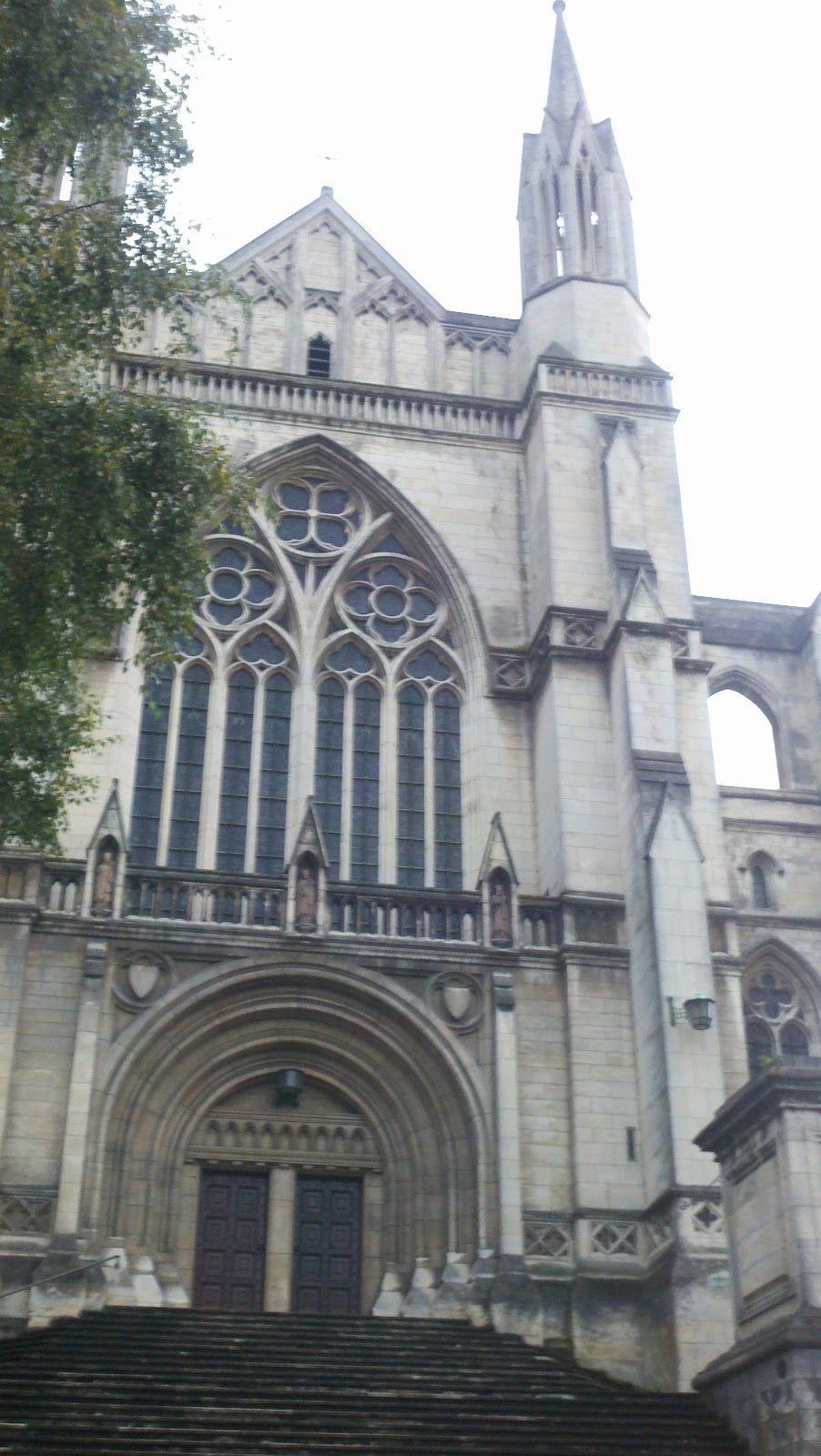
Side view of the church
Front view of church
View of Dunedin and the bay from up on the hill
Another view from up the hill

I got there Saturday evening and had time before dark to go down to the Octagon and check things out.  Apparently, I missed the big, annual "keg party" in which about 10-15,000 students (perhaps the entire student body) are out on the streets drinking and raising a ruckus.  Apparently they like to get up on rooftops and sometimes the roofs collapse.  I guess there were a few injuries, but nothing serious.  I'm grateful to have missed it! 

I took myself out to dinner and had a delicious piece of salmon.  For dessert I had this "chocolate cone"thing: 


A cone of pure dark chocolate mousse!

I also walked around and took pictures of some of the really pretty buildings. The famous railway station:

Showing how far it is to various places from the railway station

And a little information about the station

Then there was the Cadbury factory.  Apparently, Cadbury in New Zealand, and everywhere else in the world EXCEPT the US is committed to eliminating slavery from its supply chain.  Unfortunately, they sold their US operation to Hershey which is NOT showing much concern for the slave problem.  

I didn't get to take a tour, since it was late on a Saturday evening.  But...it's so close...so I will!

Then I went to visit the hospital and the med school.
Yes, they have the same problem here

Pretty mural!


Medical School building

And the "Monkey Bar" across the street

After all that, I put myself to bed to get ready for the 10 am service at the Anglican cathedral. 
Robert Burns sits in front of the cathedral forever

Beautiful prayer from the New Zealand Prayer Book


The service was fairly traditional, with a beautiful choir.  Since the Anglican church in Balclutha is so non-liturgical, it was nice to have some tradition in such a beautiful setting.  Of course, being a newcomer, it's always hard to experience one of the most important parts of going to church: the community.

The "community" part came after church, when I went to do what I had actually gone to Dunedin to do:  meet a friend from GCN called Rob.  Rob moved from the US to Australia about 20 years ago and lives in Sydney.  I met him at the conference in Denver in 2011 and when he found out I was moving to New Zealand, he decided to come over to visit and help ease my transition.  Unfortunately, I didn't pull out the camera once during the afternoon.  However, I found this photo on the internet which pretty much looks like what I saw:

Rob, Patrick (another friend from GCN) and I had lunch next to the ocean and I watched the weather change several times and surfers go in and out of the waves.  Patrick lives in Olympia, WA and I met him last year when we were there visiting Laura's aunt and uncle.  He is an anthropologist who wrote an excellent book called Thou Shalt Not Love: What Evangelicals Really Say to Gays. He used to teach in Dunedin and had brought a group of students back for an anthropological tour of New Zealand.  What a small world, eh?  After lunch, Patrick left and Rob and I stayed and talked awhile longer.  GCN is an amazing worldwide community of committed Christians who are either gay, lesbian, bisexual or transgender themselves or who are allies of those who are.  One of the things Rob told me that I've been pondering (and may have to write about eventually) is that he was once told by a pastor that, in that pastor's experience, gay Christians are almost never "lukewarm."  We're either "all in" or we're not.  I think it's true...we've usually experienced a lot of rejection from the Church and in order to actually stick it out and stay, we have to do our homework and we have to be committed.  

After my afternoon chatting with Rob, I made my way home from Dunedin.  Happily, the next day, Monday, was the Otago Anniversary (see this article on Wikipedia for a wee bit of information) so I didn't have to get up early.  My little journey to Dunedin was quite exhausting!

21 March 2012

From the doctor's perspective

I started to summarise a bit about the NZ Health system in this post.  But I've been thinking a lot about how I might describe MY experience working in it for a few weeks.  Of course, it's only been a few weeks, though I've seen LOADS of patients already.  This is a very busy practise.

The first thing I've noticed is how overall, I am much more relaxed and able to enjoy the encounters with the patients I am, compared to previous jobs I've had.  I recall the words of Ray Anton, the CEO of Clutha Health First, during my phone interview.  He said, "we want your brain to be focussed on taking care of patients, not all that other stuff."  "All that other stuff" is the stuff that has threatened to make me leave clinical practise entirely.  "Stuff" like diagnosis coding, procedure coding, E&M coding, worrying about whether the patient can afford a medication or a visit or a procedure and fighting with them to come in once a year to get their prescriptions renewed.  "Stuff" like documenting to support the coding and documenting to satisfy the lawyers of potentially litigious patients.  I spend so much less time documenting now.  And yet, I document sufficiently (there are some here who don't, for sure).  The subsidies for primary care are on a capitation basis so it really doesn't matter the complexity of the visit. The patient's copay is almost always the same.  So I'm not worried about how many "bullet points" I need to justify billing for what I know I did.  Instead of spending a couple of hours at the end of the day dictating notes or filling in templates in the EHR, I am usually done with the note as soon as I've done seeing the patient.  I look up a diagnosis that seems to fit in the EHR and I put it in.  The only extra "coding" work comes when it's an accident case, and then it's coded on time (so if there's a cast or a dressing change or whatnot that takes longer, it gets billed for more).  Granted, my learning curve is still quite steep with all the different forms, drug names, etc that I'm required to look up or go ask the nurses about every 15 minutes.  But everyone is VERY patient with me.  It seems they are grateful that I'm here and don't mind answering my incessant questions.

As for litigation, it is virtually impossible to sue a doctor.  I think I mentioned that before. It's virtually impossible to sue anyone!  I think in SOME cases that can go too far and there are doctors who get lazy.  In fact, even in other areas, it seems, there could be a bit more concern for safety. A colleague (who is a kiwi but just moved back from years in Canada) told me he was hiking and there was a sign on the track that warned of some loose ground, holes, or something.  He thought MAYBE these pitfalls might be marked but they weren't.  Whoever put up the signed figured that was sufficient warning, even though there might be unexpected holes or loose rock on a track that someone might fall into without knowing they're there.  When they say "at your own risk" they really mean it!

Anyway, the majority of my time is spent actually listening to and examining patients, figuring out what they need and finding a way to provide it.  It's the last bit that is slowing me down at the moment because it requires a lot of learning about the system, what's available in the clinic or the hospital, what can be done urgently in Dunedin, and whom to refer to and how to do it.  I spend a lot of time looking up drug names in the drug book.  I'm working making a list of important numbers, as well as units conversions because it's sometimes hard to work out quickly whether someone's cholesterol levels REALLY are in an acceptable range.

One interesting thing is that patients are required (and expect) to come in every 3 months for prescription refills if they are on chronic meds.  They don't fuss about it AND it give us ample opportunities to catch any problems early and review whether they have good BP control, etc.  Occasionally a doctor will make an exception and let a patient call in for refills but patients know those are exceptions and don't push for those exceptions.  So, although people will come with lists, if you are seeing them every 3 months, the lists are usually much shorter.

I am going to stop there because my lunch break is over and I wanted to post some of these thoughts before I lose them.  I think it's a pretty good introduction to how things are going from my perspective.  Of course, there will be more!  Cheers!

19 March 2012

Trip to the Catlins

On Saturday (the 17th of March) I had my first official day off since starting my job (not counting my trip to Queenstown which was, officially, work and didn’t allow for much time to explore).  I had planned to take a trip to the coast and perhaps drive through the The Catlins.  I didn’t expect the weather to be absolutely perfect—unseasonably warm (for ANY season, here, apparently) at 24 degrees (75 F) and a cloudless sky.  So, I packed a lunch and some warm and waterproof clothing and prepared for an extensive exploration of the area. I took with me a couple of travel guides of the area and tried to make sense of endless list of recommended routes and stopping points.  In the end, it seemed simplest  just to follow The "Southern Scenic Route" out of Balclutha and see where it took me. 

As I drove, the landscape became more and more stunning as I wove through the green rolling hills, covered with trees and cows and sheep, back dropped, as they were, by a color of blue that I’ve rarely seen in skies.  I tried to take some photos but the road is fast and windy and whenever I’d see a particular photo-worthy view, it would be too dangerous to pull over and at the next pullout, the view would be obscured.  So with that whiny disclaimer (after all, with scenery like this, it was almost impossible to go wrong with the photos) I will proceed to describe what I saw and share some of the 300 ish photos that I did manage to take. (One LAST whiny disclaimer: the only camera I have is the 8 MP one on my Android phone.  It’s not bad but it’s not that good, either).
The Southern Scenic Route
For orientation purposes, this is a map of the route and the area:
For a key to the map, click here.  I started in Balclutha, just north of the number 25 on the map and went down as far as the number 6.

As I said, the day was perfect and just driving along the highway afforded breathtaking views of the countryside.


 Just before coming to the little town of Owaka, I stopped at a cemetery to catch a few shots of the dahlias.


Since I had already fortified myself with a large, late breakfast, I decided to motor on through Owaka and stop on the way back.  My ultimate goal was to get back up to Nugget Point by about 5:30 or 6 PM because 2 hours before dusk is supposed to be prime penguin-viewing time.  So on I went and just past Owaka I wound my way up a hill and, lo and behold, at the top was a pull-out .  I looked behind me and saw this:


It just kept getting better and better!  Along the way, there were dozens of places where one could turn off to go to various points of interests or hike along one of the many tracks into the forest, along the river, or out to the coast.  At that point I had to prioritise.  There were a few waterfalls that, by their description in the travel guides, I would not want to miss.  And, of course, there were the penguins.  So I made the relatively random decision to travel down as far as McLean falls, partly because the track to the Falls sounded so lovely and partly because there is a place there called “The Whistling Frog Café” which sounded like a nifty place to stop for lunch.  Having said that, I made one more stop at the Florence Hill Lookout, which was right there on a lefthand pullout, so I couldn’t resist.

The Lookout is between two peninsulas

There's a peninsula to the south

and a peninsula to the north
and cows in between!

It was an overlook just past the town of Papatowi.  I couldn’t take a photo of the sign leading into town (too dangerous) but it’s “tagline” said “Where forest meets sea.”  The view from Florence Hill Lookout exhibits that quite nicely.  In fact, there it is…thick groves of trees right up to the sandy beach.


With that, I got back in the car and continued the  beautiful, winding drive south to McLean Falls.  One of my guides says, “The 22 metre falls on the Tautuku River are often described as the most spectacular in the region.  The walk to the falls, though uphill, is not too steep and is very pleasant.”  I wasn’t disappointed!


The trail took me through a very “wet” forest (the temperature was several degrees cooler and I was surrounded by ferns).  

Ferns
A very odd tree growing every which way, sort of reminded me of the trip through the rainforest in Mexico
Sun shining through the trees


I saw bits and pieces of the falls at first,

and then I reached the top and saw this: 

After I returned from seeing McLean Falls, I headed back toward the main road and found The Whistling Frog.   


and had a scrumptious bowl of seafood chowder (with fish, shrimp, mussels, and a variety of other delights) and a “lucky” flat white.


The cafe was also filled with really funky artwork which was for sale (and so it seemed tacky to photograph it).

Having decided that this was as far as I was going to go, I took a moment to plan my trip back.  One of the “must sees” was Purakaunui  Falls but before stopping there I decided that Lake Wilkie sounded interesting.

While on that walk, I heard a variety of  very interesting and very unfamiliar bird songs.  I hope to convince my dad to come over sometime and help sort out what these birds are!  I couldn't see them as I’d left the binoculars in the car, this time. 
Lake Wilkie
On the way back up the road, I saw some of the coastline from a different perspective.
 and stopped to take some photos of the rocky cliffs plunging into the sea.

The beach at Paptowi
 I took a short detour to the beach at Papatowi
and then I made my way to Purakaunui Falls.


The guide calls this “a true icon of the Catlins”,and “one of New Zealand’s most photographed waterfalls.”  I took quite a few, myself, and picking just the right ones to include was not an easy task.


More ferns on the track to the falls


My next stop was Owaka, a cute little town with some beautiful gardens and a few odd quirks.  

  Someone apparently had a teapot collection that got out of hand.  It has now become Teapotland.


Coming from Montana, it’s fascinating to see roses and lilies in bloom this time of year.  Remember, it’s pretty much autumn, here, now.  It would be the equivalent of seeing these in bloom in September in the Northern Hemisphere.  Maybe some places, but not Montana!


Ok, so I know you’re anxious to see the penguins.  Unfortunately, due to the quality of my camera, this is a part of the trip you’re just going to have to trust me on.  Some of my family members will remember my trip to Malawi.  We took a river cruise and waaaay off in the distance were some elephants.  At that time, I didn’t have a decent camera either (I need to get a decent camera, don’t I?) and the running joke forever after was I would point to a tiny black dot in the bush and say, “Look, can’t you see? It’s an elephant! There are elephants!”  The fact is, there really were elephants, but you really couldn’t see them in the photo.  Same with the penguins.  They really are there, and I really saw them with the binoculars, but you really can’t see them in the photos.

After leaving Owaka, I followed the signs to Nugget Point, which took me to the “penguin hide.”


Penguin "hide"
 It was a short walk down to the “hide” which was full of tourists. One thing about brilliantly beautiful weekend days is they DO attract lots of tourists.  The problem is, penguins are quite shy and of course they must know they are being watched by dozens of people, even with the hide there!  Anyway, the tourists were looking at a pair of penguins in the grass up on the bank, which I got a good view of with the binoculars, then we saw another one waddle out of the water to join them.  There it is, see?  That tiny speck just up in front of the brownish blobs (which are rocks and seaweed).

 And there, in the grass, there is a grayish-white speck?  That’s the pair of penguins.  By this time the other one had found it’s way up the grass and it’s standing in the bottom right corner of the picture—a whitish blob just in front of the shrubby plants.  You’re just going to have to trust me on this one…or better yet, come see for yourself!


"The Nuggets" which, in the setting sun, look like nuggets of gold
Having achieved my one goal for the day, I made my way to the Lighthouse at Nugget Point.  Nugget Point is named for the “nuggets” of rock that sit out in the water.  Along the walk up to the end of the point, and the Lighthouse, there are steep, plunging cliffs off to the side and, with binoculars, I was able to see cormorants (which they calls “shags” here), fur seals and elephant seals.  Again, they were too far for the camera to pick up. However, I did photograph some quite excellent views.

A butterfly on a sign

Down below the track, around this little pool of water, there were some seals resting.  You might just be able to make out some dark blobs just on the edge of the water.

Seals, see?

Another view of the Nuggets


Incredible blue water
By this time, the sun was starting to set,

 and my phone/camera’s battery was about dead.  So I got back in the car and made one more stop at Kaka Point, which is a tiny beach town about 25 km outside of Balclutha.


Kaka Point

And with that, I turned my car back toward home and put my very tired body to bed!


I have many more photos, some good, some not so good.  And there are many more to be taken, preferably by someone with a really good camera and some photography skills.  However, this should give you a rough idea of the spectacular day I had in the Catlins and the stunning surroundings that are very close at hand to my new home.  I’m open for visitors!  Just let me know in advance so I can take time off work.